HomeUncategorizedThe Guard Thought a Pregnant Prisoner Was Defenseless… Until He Became the One in Chains
The Guard Thought a Pregnant Prisoner Was Defenseless… Until He Became the One in Chains
July 11, 2026
Marisol had learned one thing very quickly inside Blackstone Women’s Correctional Facility:
nighttime was when the walls became the most dangerous.
During the day, the prison was loud—metal doors slamming, inmates shouting, guards barking orders, carts rattling down concrete corridors. There were witnesses in the daytime. Cameras. Procedures. Enough noise to make evil hesitate.
But at night, especially in solitary, the building seemed to breathe differently.
The lights dimmed to a sick yellow. The hallways emptied. Every sound became sharper. And fear had room to grow.
Marisol was seven months pregnant when they moved her into the isolation cell.
Officially, the reason was “medical observation after an altercation.” That was the phrase the paperwork used. Clean, cold, harmless. But the truth was much uglier. She had raised her voice that morning after another inmate tried to steal her meal tray. A guard said she was being disruptive. Another said she needed to “cool off.” So they took her from the general wing and locked her in a narrow concrete box with a steel bed, a thin mattress, a toilet in the corner, and an iron door that swallowed all sound.
She sat on the edge of the bed with both hands over her stomach, listening to her baby move.
“Just stay calm,” she whispered. “Just get through the night.”
She had no family coming. No lawyer she trusted. No one on the outside checking on her every hour. The father of her child had disappeared the week she was arrested, and the state had already decided what kind of woman she was.
Convict. Troublemaker. Pregnant inmate.
To most people, that was all she would ever be.
A little after midnight, footsteps stopped outside her cell.
Marisol stiffened.
She recognized the rhythm before she even saw him.
Officer Dwayne Keller.
He was the kind of guard who smiled too much when nobody else was around. Too friendly in public, too comfortable in private. He liked to lean too close, talk too softly, act like every locked door was his kingdom. Marisol had spent the last two weeks avoiding his eyes, refusing his jokes, turning away when he lingered at her bars longer than necessary.
Tonight, when he appeared in the narrow window of her iron door, something in his face made her blood turn cold.
He unlocked the door slowly.
“What do you want?” she asked, standing up.
“Routine check,” he said.
Nobody did routine checks like that.
He stepped inside and shut the heavy iron door behind him. The lock clicked.
Marisol’s heart began to pound.
Then she saw him glance up at the security camera in the corner.
Without a word, Keller reached up with his baton and nudged it sideways until it faced the wall.
The red light still blinked.
But now it saw nothing.
Marisol took a step backward. “Why did you turn the camera?”
Read More
Keller didn’t answer right away. He removed his jacket and dropped it over the back of the metal chair near the bed. Under the harsh yellow light, his shadow stretched across the floor toward her.
“No one’s coming down this hall for a while,” he said casually. “You and me can talk.”
“I don’t want to talk.”
He smiled.
“You should be more polite. I’m the one making sure you get your extra blanket. Your food. Your meds.”
Marisol moved until the backs of her legs hit the bed frame. “Stay away from me.”
His expression hardened. “You think you’ve got attitude because you’re carrying a baby?”
She wrapped one arm protectively around her stomach. “I said stay away.”
But he kept coming.
He moved slowly at first, like he wanted her to understand exactly how alone she was. The cell was too small. Too silent. Every inch he took forward pushed the air out of her lungs.
Marisol looked toward the alarm button outside the cell door window, knowing she couldn’t reach it. She looked at the camera, still pointed at the wall. She looked at the tiny slit in the door where a tray could pass through, and knew no one could see enough through it to know what was happening.
Keller stopped right in front of her.
“You know,” he said, voice low, “some inmates learn to cooperate. Makes life easier.”
Marisol’s throat tightened. “Please,” she whispered. “I’m pregnant.”
He didn’t care.
His hand closed around her arm.
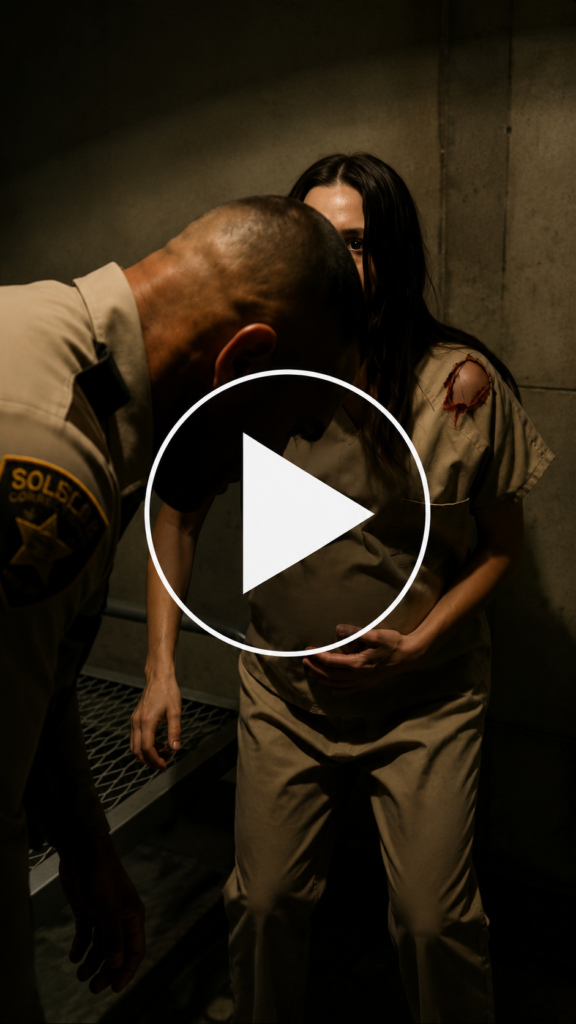
She cried out and tried to pull back, but he yanked her toward the corner beside the bed. Her shoulder hit the concrete wall. With one rough movement, his grip tore the fabric of her prison uniform near the shoulder seam. The cloth ripped with a sharp sound that echoed through the cell.
Marisol gasped.
“Stop!” she shouted. “Don’t touch me!”
But Keller only pressed closer, one forearm pinning her. “No one can hear you,” he said.
For a second, raw panic overtook her.
Not for herself.
For the child inside her.
She imagined falling. Hitting the floor. Losing the baby in this room while the camera stared at blank concrete. And in that terrible instant she understood that fear alone would not save her.
So she did the one thing he would never expect.
She went still.
Her body sagged. Her face twisted in pain. She let out a weak cry and bent slightly, cradling her belly as if she might collapse.
Keller paused.
The change in her was immediate enough to unsettle him. “What’s wrong?” he muttered.
“My stomach…” she breathed. “Please… please…”
He loosened his grip just enough.
That was his mistake.
Marisol had already noticed the handcuffs earlier that evening. One pair hung from a hook bolted beside the steel bed frame, left there carelessly during a prior inspection. At the time she had barely thought about them. Now they gleamed like the only chance she had.
Still pretending to be weak, she stumbled sideways.
Keller grabbed at her again—closer now, leaning in, careless.
And in one sudden movement, Marisol snatched the cuffs off the hook, caught his wrist, and snapped one bracelet shut around it.
Before he could react, she swung the other half around the vertical iron bar of the bed frame and locked it tight.
The click rang louder than a gunshot in that tiny cell.
Keller froze.
Then he jerked backward with a curse—but the cuffs held.
“What the hell—!”
He pulled harder, twisting, but the bed frame was bolted into the floor. The metal bit into his wrist. Panic flashed across his face for the first time.
Marisol staggered back, breathing hard, one hand on her belly, the other gripping the wall for balance.
Keller lunged again, but the chain snapped him short. “Unlock these!” he shouted.
She stared at him, chest rising and falling.
He was no longer the hunter in the room.
He was trapped. Off-balance. Furious.
And suddenly afraid.
“Marisol,” he hissed, trying to regain control, “you don’t understand what you’re doing.”
“No,” she said, her voice trembling at first, “you didn’t understand.”
He rattled the cuffs harder. “Let me go right now, and maybe I can still help you.”
She gave a hollow laugh.
“Help me?”
He looked toward the door. “If another guard sees this, they’ll say you attacked me.”
“Then they’ll have to explain why the camera is turned to the wall.” Her voice grew steadier with every word. “Why my uniform is torn. Why you locked the door.”
His face changed.
The confidence was gone now.
Marisol stepped farther back, protecting her stomach, never taking her eyes off him. Her shoulder throbbed where he had grabbed her, and her whole body shook from adrenaline, but she forced herself to stand tall.
Keller pulled once more, desperately, and the bed frame screeched across the floor an inch before jamming. “You crazy—”
“No,” she said, coldly. “I survived.”
Then she looked at him the way prisoners looked at locked doors every single day—with the quiet certainty that metal could humble anyone.
“Now you’re the prisoner.”
For a few long seconds, neither of them moved.
Then Keller started yelling.
“Help! Open this door! She attacked me!”
His voice bounced down the corridor.
Marisol almost laughed at the irony.
A minute later, footsteps thundered outside. Keys rattled. Voices rose.
When the cell door finally opened, two officers and the night supervisor rushed in—then stopped dead.
There stood Marisol, bruised, uniform torn at the shoulder, one arm around her belly.
And there was Officer Keller, handcuffed to the iron bed like the criminal he had tried to make her become.
The supervisor’s eyes lifted slowly toward the camera pointing at the wall.